Learning a new language often creates a frustrating gap between knowing a word and actually being able to use it.
You may recognize hundreds or even thousands of words while reading, understand them when someone else speaks, and still struggle to produce a simple sentence during a real conversation.
That is the problem OpenQuiz is trying to solve.
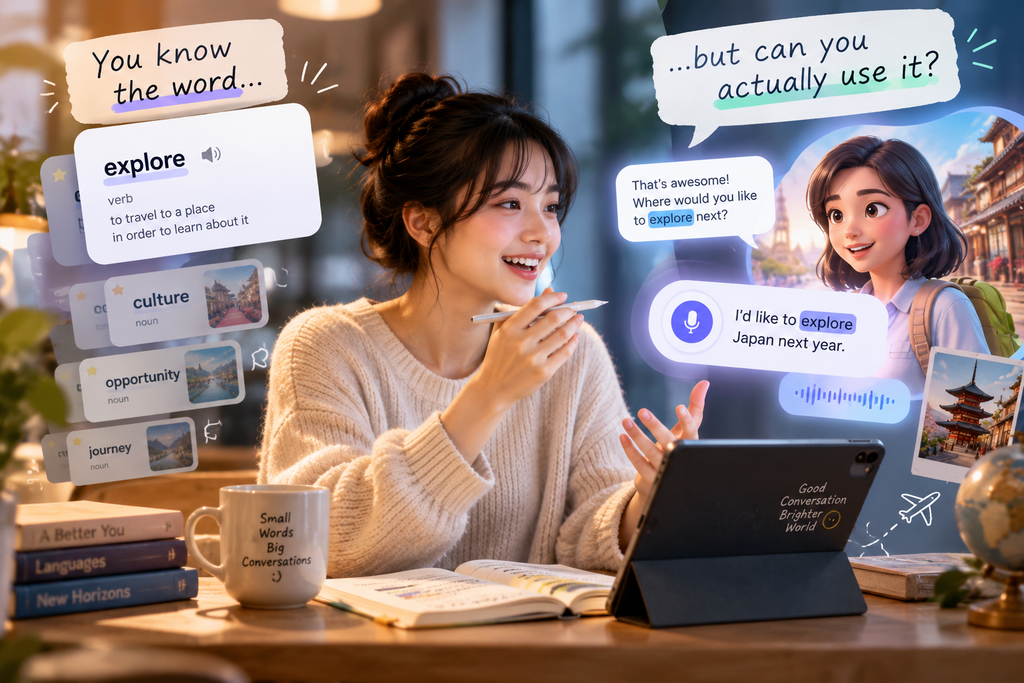
Rather than treating vocabulary as something you simply memorize and review, OpenQuiz builds a learning process around a bigger goal: turning passive vocabulary into words you can actively use when speaking.
The platform combines AI-generated flashcards, spaced repetition, contextual exercises, grammar practice, AI conversations, and pronunciation scoring in one learning flow. It supports more than 50 languages and offers a free tier with unlimited access to several core learning features.
So, what does OpenQuiz actually do, and is it more useful than a traditional flashcard app?
What Is OpenQuiz?
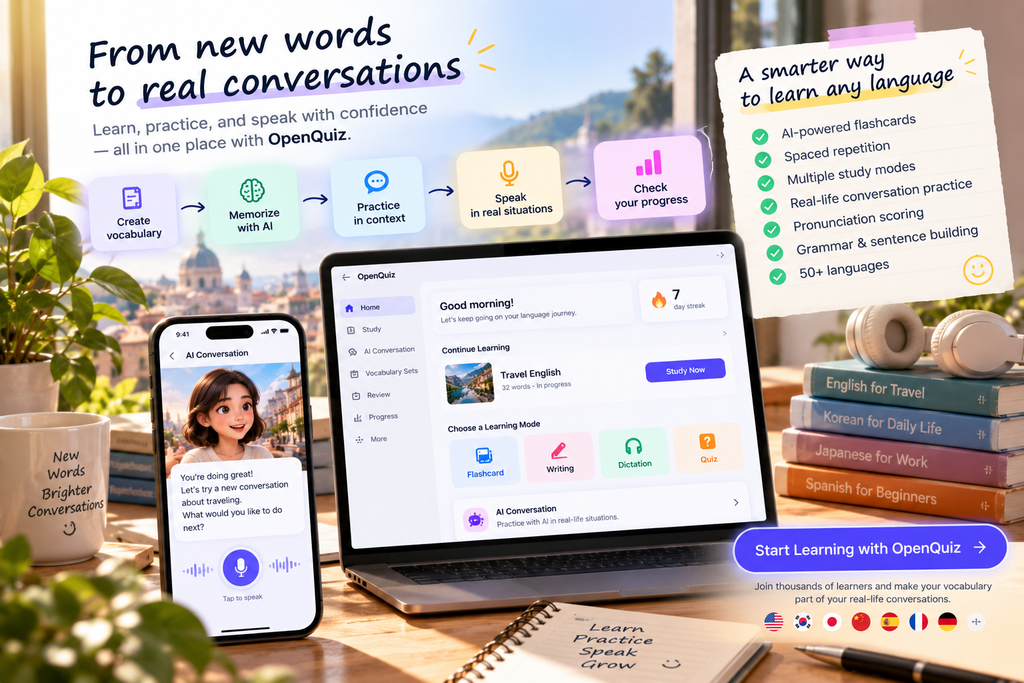
OpenQuiz is an AI-powered language learning platform designed around vocabulary retention and active speaking practice.
At first glance, it may look like another flashcard-based language learning website. But its approach is broader.
Instead of stopping after you memorize a word, OpenQuiz encourages you to move through several stages:
Create your vocabulary → memorize it → practice it in context → use it in conversation → check your pronunciation.
This makes the platform particularly interesting for learners who already know a reasonable amount of vocabulary but have difficulty using that vocabulary naturally.
OpenQuiz currently supports more than 50 languages, including English, Korean, Japanese, Chinese, Spanish, French, German, and others. It can also be used for different goals such as everyday communication, work, travel, and exam preparation.
1. Create Vocabulary Sets With AI
One of the first things that makes OpenQuiz different from a basic flashcard tool is how it handles vocabulary creation.
You can create your own study sets instead of relying entirely on pre-made material.
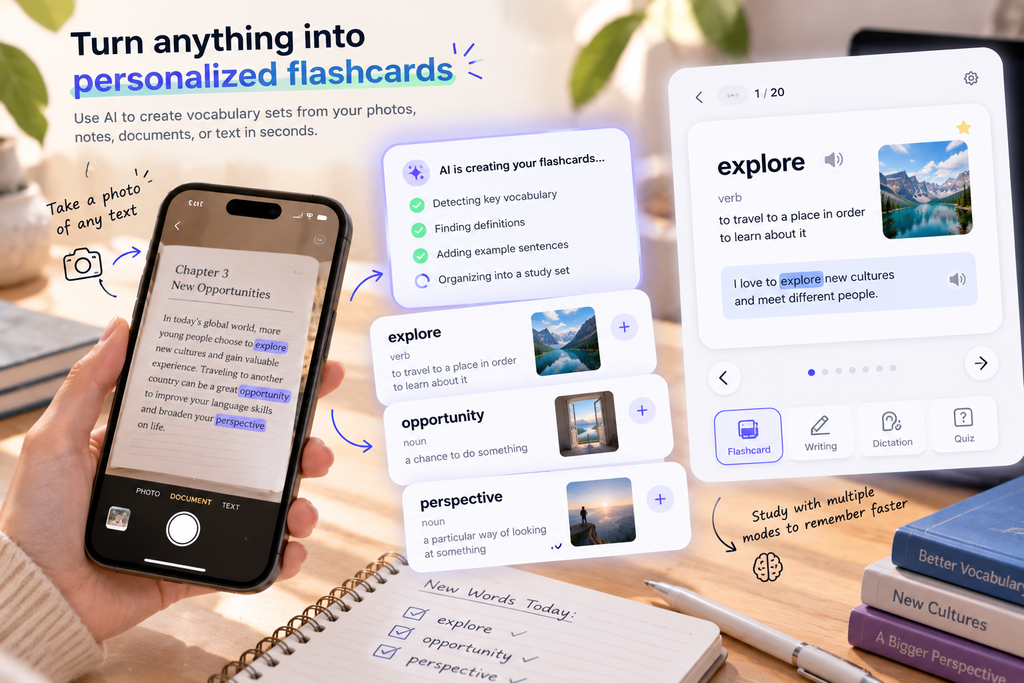
More importantly, OpenQuiz can use AI to help create those sets.
For example, imagine you are reading an English article and find several unfamiliar words. Instead of manually creating every flashcard from scratch, you can use the platform’s AI-powered tools to turn content into a study set.
The platform specifically promotes a photo-to-flashcard workflow. You can take a picture of text such as a textbook page, menu, document, or sign, and AI can identify useful vocabulary and build flashcards from it.
This can be useful because vocabulary is often easier to remember when it comes from something you actually encountered.
You are not simply studying a random list of words.
You are studying words that came from content you were already interested in.
Personalized Learning Paths
OpenQuiz also uses AI to create learning paths around specific goals.
Instead of starting with a completely empty vocabulary list, you can build learning material around purposes such as travel, work, daily communication, or exams.
The idea is simple: your vocabulary should match what you actually need to do with the language.
That can make the learning process feel more focused than memorizing disconnected word lists.
2. Flashcards Are Only the Beginning
Flashcards remain an important part of OpenQuiz.
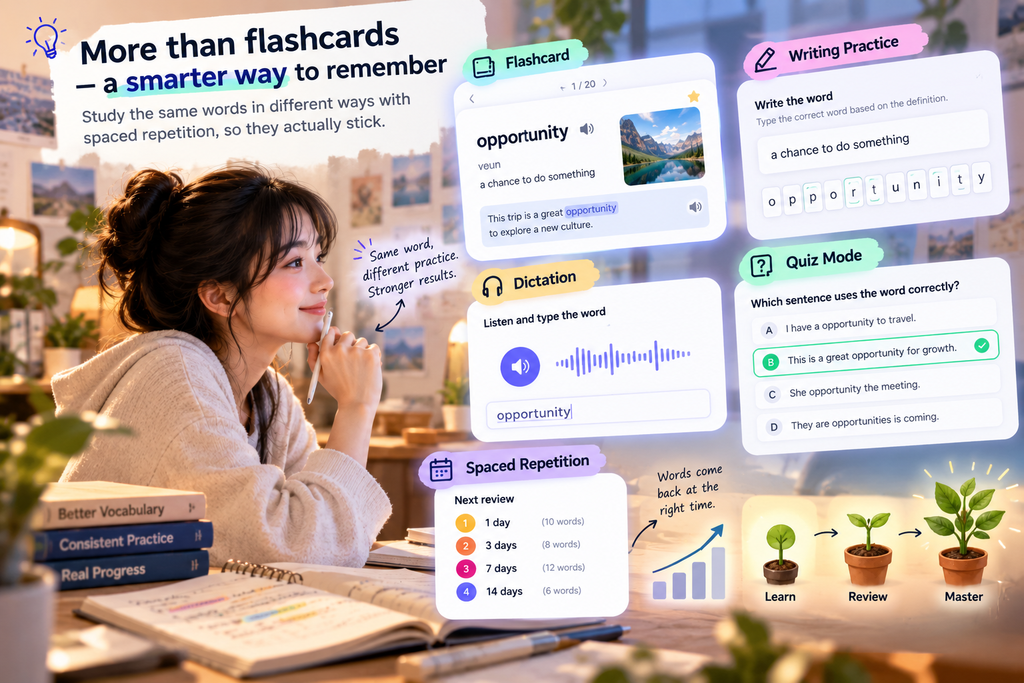
The platform provides several ways to review vocabulary, including:
- Flashcards
- Writing exercises
- Dictation
- Quizzes
- Spaced repetition
- Active recall exercises
This variety matters because repeatedly looking at the same flashcard is not necessarily enough to make a word easy to retrieve.
Sometimes you need to recognize a word.
Sometimes you need to write it.
Sometimes you need to hear it and reproduce it.
And eventually, you need to use it yourself.
OpenQuiz allows the same vocabulary to be practiced through different study modes rather than keeping everything inside a single flashcard format.
3. Spaced Repetition Helps You Remember What You Learned
One of OpenQuiz’s core learning methods is spaced repetition.
Instead of reviewing every word at the same frequency, spaced repetition schedules reviews at different intervals so that vocabulary can be revisited when it is more useful to do so.
This is especially important for language learning because the goal is not simply to remember a word for one afternoon.
You want to still recognize and retrieve it days or weeks later.
OpenQuiz combines spaced repetition with active recall and contextual exercises, creating a learning loop where vocabulary is repeatedly revisited instead of being forgotten after the first study session.
The platform says its free plan includes unlimited spaced repetition, so learners can continue using the core review system without a time-limited trial.
4. Learn Words in Context Instead of Isolation
This is one of the more important parts of OpenQuiz’s approach.
Knowing the definition of a word does not necessarily mean you know how to use it.
For example, you might remember the meaning of a word such as “resilient”, but that does not automatically mean you can place it naturally into a conversation.
OpenQuiz tries to bridge this gap by putting vocabulary into sentences and contextual exercises.
Instead of only seeing:
resilient = able to recover quickly
you may encounter the word inside a complete sentence or exercise where you have to actively retrieve and use it.
The platform includes activities involving sentence completion, translation, grammar patterns, and other contextual exercises.
This approach is particularly useful for learners who already have a decent vocabulary but feel that their words remain “stuck” in recognition mode.
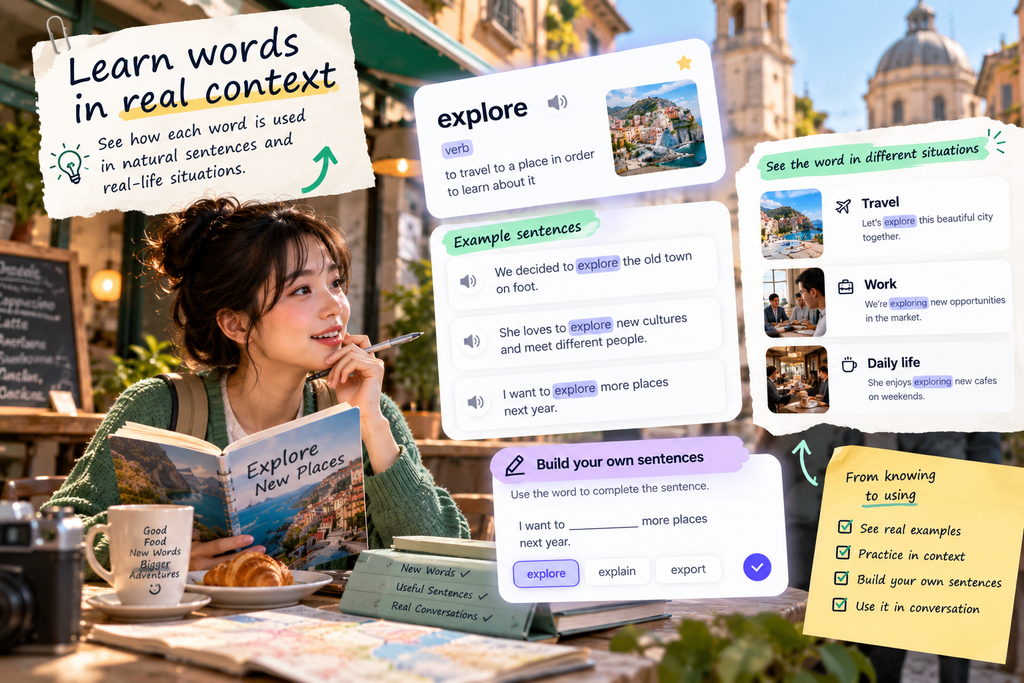
5. Grammar and Sentence Building
OpenQuiz is not limited to vocabulary memorization.
It also includes interactive grammar and sentence-building exercises.
These can involve:
- Translating sentences
- Arranging words into the correct order
- Recognizing grammar patterns
- Practicing grammar inside meaningful sentences
This is useful because vocabulary and grammar are difficult to separate when you actually communicate.
Knowing the right words is only part of the process.
You also need to know how those words fit together.
For example, learning individual words such as “deadline,” “meeting,” and “prepare” is useful. But being able to combine them into a natural sentence is a different skill.
OpenQuiz’s contextual exercises are designed to help move learners toward that second stage.
6. AI Conversation Practice
This is arguably the feature that gives OpenQuiz its strongest identity.
Traditional flashcard platforms are very good at helping you memorize information.
But memorization alone does not guarantee speaking ability.
OpenQuiz therefore takes vocabulary from the study stage and moves it into simulated conversations.
The AI can create scenarios based on real situations such as:
- Ordering food
- Traveling
- Job interviews
- Business situations
- Everyday conversations
The important part is that the learner is encouraged to actively use the vocabulary they have been studying.
That creates a more natural progression:
Learn the word → remember the word → see it in context → use it yourself.
OpenQuiz describes this as moving vocabulary from passive knowledge into active speaking.
For learners who can understand English reasonably well but freeze when they need to speak, this could be one of the platform’s most useful features.
7. Pronunciation Scoring Gives You Something Concrete to Improve
Speaking practice becomes more useful when you can identify what went wrong.
OpenQuiz includes pronunciation scoring that evaluates different aspects of a spoken response.
Its example scoring system breaks pronunciation performance into areas such as:
- Accuracy
- Fluency
- Completeness
- Prosody
It can also show scores for individual vocabulary items, helping learners identify which words may need additional practice.
This is more useful than simply receiving a generic “good” or “try again.”
For example, if your overall score is reasonable but one particular word consistently receives a lower score, you have a much clearer target for your next practice session.
The purpose is not simply to give you a number.
It is to turn speaking practice into something you can evaluate and repeat.
8. More Than 50 Languages
OpenQuiz is not limited to English.
The platform currently advertises support for more than 50 languages, including major languages such as English, Korean, Japanese, Chinese, Spanish, French, German, and others.
This makes the platform potentially useful for different types of learners.
Someone preparing for an English exam may use it differently from someone learning Korean for travel or Japanese for everyday communication.
The underlying workflow remains similar:
Build vocabulary → review it → practice it in context → use it actively.
That consistency makes the platform easier to understand even when the learning goal changes.
9. What Can You Use OpenQuiz For?
OpenQuiz is flexible enough to fit several learning situations.
Everyday Language Learning
If you are learning a language casually, you can create vocabulary sets around the words you encounter in daily life.
You can then review them regularly and practice using them in sentences.
Exam Preparation
Learners preparing for exams can organize vocabulary around specific goals and study topics.
OpenQuiz also promotes learning paths related to areas such as IELTS, TOEIC, TOPIK, JLPT, HSK, and English for work.
Work and Professional Communication
For someone learning vocabulary related to meetings, presentations, interviews, or business communication, contextual practice can be more useful than memorizing a general-purpose vocabulary list.
Travel
Travelers can build vocabulary around situations they are likely to encounter, then use conversation practice to rehearse those situations before traveling.
This is where the combination of vocabulary and simulated conversation makes the platform particularly practical.
10. What Is Free on OpenQuiz?
One of OpenQuiz’s biggest advantages is that it does not force users into a short trial before they can use the core learning system.
The platform currently offers a Free Forever plan.
The free tier includes core features such as:
- Unlimited spaced repetition
- Unlimited spelling practice
- Manual flashcard creation
- Basic study modes
- Unlimited vocabulary sets and memorization
No credit card is required to start.
Premium is designed for learners who want the more advanced AI features, including unlimited AI flashcard generation, personalized AI learning paths, unlimited conversation practice, and AI photo-to-flashcard functionality.
This creates a fairly clear distinction:
Free = build and memorize vocabulary.
Premium = unlock more AI-powered creation and speaking practice.
That makes it possible to test the basic learning experience before deciding whether the additional AI features are worth paying for.
11. Where OpenQuiz Stands Out
The easiest way to understand OpenQuiz is to look at what happens after you memorize a word.
A traditional flashcard workflow may end with:
“I remembered the answer.”
OpenQuiz tries to continue the process:
“Can I use the word in a sentence?”
Then:
“Can I use it in a conversation?”
And finally:
“How well did I actually pronounce it?”
That progression is what makes OpenQuiz more interesting than simply another flashcard website.
Its strongest idea is not any individual feature.
It is the way several features are connected into one learning loop.
Things to Keep in Mind
OpenQuiz is not going to magically make someone fluent just because they use the platform.
The quality of the experience still depends heavily on how consistently you practice and whether you eventually use the language with real people and real content.
AI conversation can provide useful practice, but it is still simulated conversation.
Likewise, pronunciation scores can help identify areas to work on, but a score should be treated as feedback rather than an absolute measurement of your speaking ability.
The platform works best when it becomes part of a broader learning routine rather than being treated as the entire language-learning solution.
Final Verdict
OpenQuiz takes a familiar idea — vocabulary flashcards — and pushes it toward a more complete language-learning workflow.
Its biggest strength is the connection between memorization and active use.
You can create vocabulary with AI, review it through spaced repetition, practice it in context, work on sentence construction, use it in AI conversations, and receive pronunciation feedback along the way.
That makes OpenQuiz particularly appealing for learners who have experienced the frustrating situation of knowing plenty of vocabulary but struggling to actually speak.
It is not simply about learning more words.
It is about getting those words out of your head and into your conversations.
If your biggest language-learning problem is the gap between “I know this word” and “I can actually use this word,” OpenQuiz is definitely worth trying.